
How to Play Live Dealer Casino Games: What to Expect and How to Get Started
May 27, 2026
The global live dealer casino market reached $7.8 billion in 2024, consistently expanding at a quicker pace than traditional RNG-based games in recent years. This is because a large segment of players prefer seeing a real dealer, real cards, and real equipment over outcomes generated by software. For those players, live dealer casino games close the gap between the convenience of online play and the authenticity of a physical casino.
This article breaks down what live dealer games are, how they differ from standard online casino games, which titles are most popular, and how to get started from your first session through your first bet.
What Are Live Dealer Casino Games?
Live dealer casino games are casino titles streamed in real time from a studio or dedicated casino floor, operated by a professional dealer on camera. The player watches the game unfold via video stream, interacts through a digital interface, and places bets that are processed against actual physical outcomes — a card drawn from a real deck, a roulette ball landing on a numbered pocket.
Four characteristics define the format:
- Real dealers and real equipment: Cards are physically shuffled and dealt; roulette wheels are physical; dice are rolled by hand.
- Live video stream: HD video feed of the dealer and game table, typically shot from multiple angles.
- Real-time interaction: A chat interface allows communication with the dealer and, in most cases, other players at the table.
- Non-RNG outcomes: Results are determined by physical gameplay, not by an algorithm.
The practical difference from RNG games matters to many players. RNG (random number generator) games simulate card draws and dice rolls mathematically. Live dealer games replace that simulation with actual physical equipment, visible to the player throughout the session.
Advantages of Live Dealer Games
Authenticity is one of the main reasons players move from RNG games to live tables. Seeing a real dealer handle cards or spin a wheel makes the experience feel more real and removes some of the distance of software-based play.
This also adds transparency. Every step, from the shuffle to the final result, happens on camera, so players can watch outcomes unfold rather than rely only on the system.
Live games also introduce a social element. Chat features let players interact with the dealer and sometimes others at the table, which creates a more engaging experience than playing alone.
In games like blackjack, player decisions matter too. Choosing when to hit, stand, double, or split can influence the result, adding a level of involvement beyond pure chance.
Disadvantages of Live Dealer Games
There are a few trade-offs to keep in mind with live dealer games. They tend to move more slowly than RNG versions, since everything happens in real time with a dealer. If you prefer a faster pace, standard online versions of the same games will feel much quicker.
Minimum bets are usually higher as well. While some tables start at lower limits, many sit in the $10 to $25 range, especially during busier hours when demand is higher.
Availability can also vary. Not every table or game runs 24/7, so if you’re looking for a specific variant at an off-peak time, options may be limited.
A stable internet connection is important too. Live games rely on video streaming, so a weak connection can lead to buffering or missed rounds.
Finally, it’s worth remembering that the house edge still applies. Live dealer games may feel more immersive, but they don’t offer better odds, just a different kind of experience.
Popular Live Dealer Games

Blackjack
Live blackjack is the most widely played live dealer game by table count. The objective is to reach a hand value closer to 21 than the dealer without exceeding it. Player decisions (hit, stand, double down, or split) are the core of each hand.
With basic strategy applied correctly, the house edge on live blackjack drops to approximately 0.5%. That makes it one of the lowest-edge games available in the live casino format.
Roulette
Roulette requires no player decisions beyond bet placement. The objective is to predict where the ball will land on a spinning wheel.
Betting options range from specific numbers (highest payout, highest variance) to broad categories, red or black, odd or even, which pay close to even money with a house edge of 2.7% on European tables. American roulette, with an additional double-zero pocket, carries a house edge of 5.26%.
Baccarat
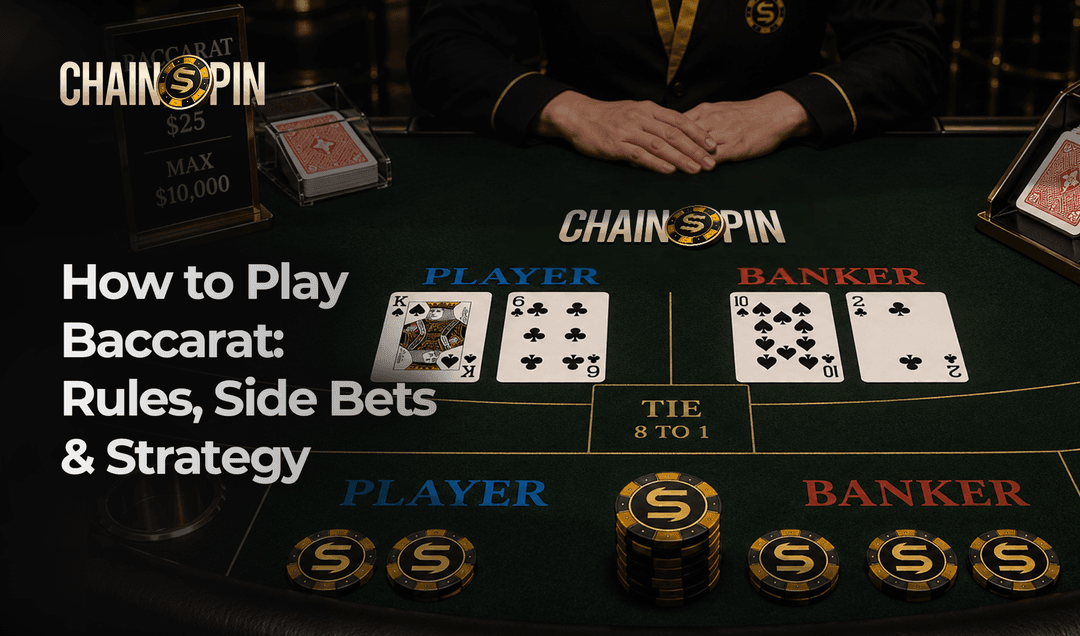
Baccarat is one of the simplest live dealer games mechanically. Players predict whether the Banker hand, the Player hand, or both hands will tie. The Banker bet carries a house edge of 1.06%; the Player bet carries 1.24%. No further decisions are made once bets are placed; card drawing follows fixed rules automatically. The tie bet, which pays 8:1 or 9:1, carries a house edge of approximately 14%, making it a bet most experienced players avoid.
Poker Variants
Live poker at online casinos typically takes the form of player-versus-dealer games rather than competitive poker. Three Card Poker, Caribbean Stud, and Casino Hold’em all follow the format of beating the dealer’s hand rather than other players. House edges run from 2% to 4% depending on the variant and bet type. Player decisions, fold or call, add a limited strategic layer.
Game Shows
Live game shows are the fastest-growing format in the live dealer category. Crazy Time Live by Evolution topped the most-played live dealer rankings in 2024, averaging 351,365 hourly players per day. Dream Catcher, Monopoly Live, and similar titles combine a spinning wheel or game board with bonus round multipliers. House edges range from 2% to 8% depending on the specific bet and multiplier selected.
Getting Started with Live Dealer Games
The setup process on Chainspin, from account creation to first bet, takes under ten minutes.
Step 1: Choose a game
Browse the live casino section and select a title. For first-time players, live blackjack or baccarat offer straightforward rules and visible table limits. Game show titles like Crazy Time require no prior knowledge.
Step 2: Check table limits
Every table displays its minimum and maximum bet before you join. Verify the minimums match your bankroll before entering. Low-limit tables are available across most game types.
Step 3: Join the table
Click to enter an active table. If seats are full, wait for the next available spot. Most live blackjack tables have between 7 and 12 seats; some studios offer unlimited player capacity on a single dealer.
Step 4: Place your bet
Select a chip value, click or tap your bet on the table layout, and confirm before the betting timer closes. The dealer announces when betting is closed; bets placed after that point are rejected.
Step 5: Play the hand or round
Watch the dealer conduct the game. In blackjack, a prompt appears when a decision is required. You must act within the allotted time or the game defaults to stand. In roulette and baccarat, no decisions follow the initial bet.
Step 6: Collect winnings
Winning bets are credited to the account immediately at the end of the round. The next round begins within seconds.
Understanding Live Dealer Game Rules
- Blackjack – The dealer must hit on 16 or lower and stand on 17 or higher. Players can double down on any two-card hand, adding up to 100% to the bet for one extra card. Pairs can be split into two hands, though some versions limit split aces to one additional card each.
- Roulette – Betting closes when the dealer calls “no more bets.” After that, bets cannot be changed. The wheel is spun, the result is announced, and payouts are handled automatically.
- Baccarat – Card drawing follows fixed rules with no player decisions after betting. Aces count as 1, cards 2 to 9 at face value, and 10s and face cards as 0. Only the last digit of the total matters.
- Poker Variants – Rules depend on the game. Three Card Poker uses three-card hands, while Casino Hold’em uses community cards. The main choice is whether to fold or call, so understanding hand rankings beforehand is important.
Strategies for Popular Live Dealer Games
- Blackjack – Basic strategy helps reduce the house edge by guiding decisions for every hand. Common rules include always splitting aces and 8s, never splitting 10s or 5s, doubling on 11 against dealer 2 to 10, and standing on 17 or higher.
- Roulette – No betting system changes the odds. Each spin is independent. Even-money bets are more consistent, while single-number bets offer higher payouts with low probability. Choosing European roulette lowers the house edge compared to American.
- Baccarat – Banker bets win slightly more often and have the lowest house edge despite the commission. Player bets are a close alternative. Tie bets carry a much higher house edge and are generally not worth it.
Common Mistakes to Avoid
Playing without understanding the rules
Jumping into a game without knowing how it works can lead to unnecessary losses. Simple things, like using double down in blackjack at the wrong time or betting on a tie in baccarat without understanding the odds, can quickly add up.
Going beyond your session budget
It’s easy to keep playing during a losing run, especially when trying to recover losses. In reality, increasing bets under pressure only makes the situation worse over time.
Chasing losses
This is a common habit in live dealer games. The slower pace can create a false sense of control, but the odds remain the same. Extending a session to win back losses usually leads to further losses instead.
Ignoring connection quality
A stable internet connection matters in live games. Buffering, missed actions, or timed-out decisions can directly affect your play, especially in games like blackjack where timing matters.
Responsible Live Dealer Gaming
Chainspin’s responsible gambling tools work the same for live dealer games as they do across the platform. Setting deposit or loss limits before you start playing is the simplest way to stay in control, and these can be configured in your account settings at any time.
Live games feel more immersive, which can make sessions last longer than expected. The real-time pace and interaction at the table make it easy to keep playing, so planning clear break points between sessions helps maintain balance.
It’s also worth keeping expectations realistic. Live dealer games are still built around a house edge, so they should be treated as entertainment with a set budget. Sticking to that budget and avoiding the urge to chase losses is key.
If gambling starts to become a concern, support is available through Chainspin, including cooling-off periods and self-exclusion options.
Getting Started with Live Dealer Play
Getting started with live dealer games on Chainspin requires no prior casino experience. Games like blackjack, roulette, and baccarat are easy to follow, and the platform handles bets and payouts automatically while dealers guide each round.
To begin, choose a game, check the table limits, and start with a small bet while you watch a few rounds. This helps you get comfortable before increasing your stakes.
Once your account is set up, you can access the full live casino right away. The welcome bonus can extend your first sessions, and tools like deposit limits are available in settings to help you stay in control.
Frequently Asked Questions
Are live dealer games fair?
Yes. They use real cards and roulette wheels, with results visible on camera. While the house edge still applies, each outcome can be seen as it happens. Chainspin’s live tables operate with full transparency.
What is the house edge in live dealer games?
It depends on the game. Blackjack can be around 0.5% with good strategy, European roulette 2.7%, baccarat about 1% on Banker bets. The house edge is always present, regardless of format.
Can I play live dealer games on mobile?
Yes. They work on both iOS and Android via browser or app. A stable connection is important for smooth play, but all games are fully accessible on mobile.
What internet speed do I need?
At least 2 Mbps works, but 5 Mbps or more is recommended for smooth HD streaming. A stable WiFi connection is usually more reliable than mobile data.
Can I interact with the dealer?
Yes. Live tables include chat, and dealers usually respond between rounds. You can ask questions or just follow along with the game.
What is the minimum bet?
It varies by table. Some start as low as $1–$5, while many are in the $10–$25 range. Limits are always shown before you join.
Are live dealer games faster or slower than RNG games?
Slower. Everything happens in real time, so rounds take longer. RNG games are much faster but less interactive.
Can I use strategy in live dealer games?
In some games, yes. Blackjack and certain poker variants involve decisions that affect outcomes. Roulette and baccarat do not offer strategy beyond bet choice.
What if I have a technical issue during a game?
Reconnect or refresh the app. If a bet was affected, support can review it using session details. Chainspin’s support team is available 24/7.
Are live dealer games better than RNG games?
They offer a different experience. Live games focus on realism and interaction, while RNG games are faster and simpler. Both have a house edge.