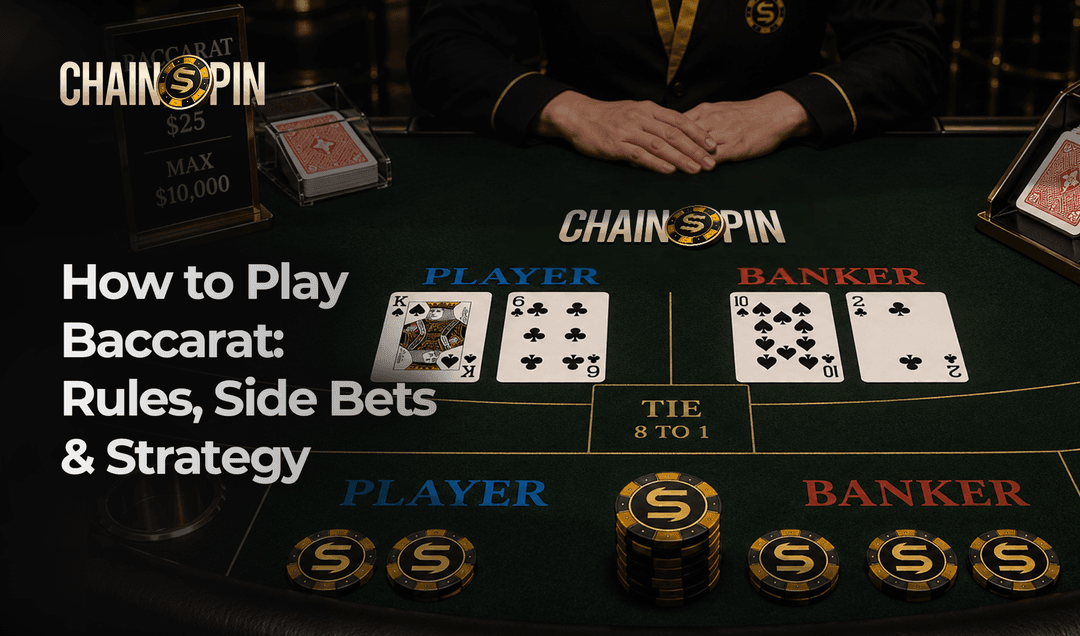
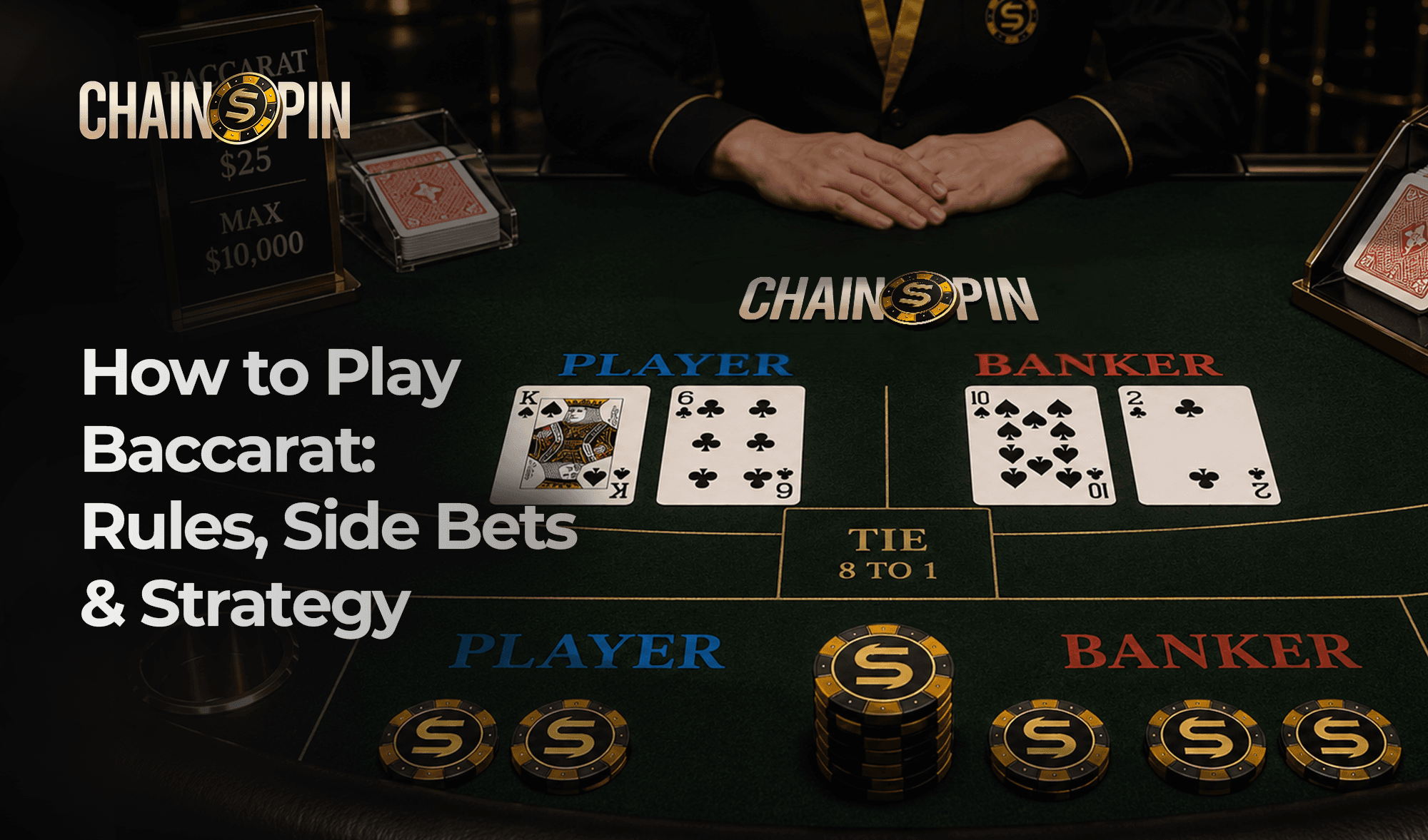
How to Play Baccarat: Rules, Side Bets, and Why It's Popular in Crypto Casinos
June 3, 2026
Baccarat generates more gross gaming revenue than any other table game in the world. In Macau, the game consistently accounts for over 80% of total casino earnings. That dominance is no longer confined to Asia. Western casinos and online platforms have seen steady growth in baccarat’s player base, and the game now ranks among the most-played titles at crypto casinos globally.
Part of that appeal comes from how accessible baccarat is. Unlike blackjack or poker, players make no strategic decisions mid-hand. Outcomes follow predetermined drawing rules, which makes the game fast, transparent, and easy to follow from the first round.
This article breaks down how to play baccarat, covering the rules, card values, betting options, drawing mechanics, side bets, and the strategy principles that give players the best mathematical chance at the table.
Baccarat Basics
The objective in baccarat is to predict whether the Player hand or the Banker hand will finish closer to 9, or to bet that both hands tie. The hand with the higher value wins, and no hand can exceed 9.
Card values work as follows:
- Number cards (2–9): face value
- 10, Jack, Queen, King: worth 0
- Ace: worth 1
When a hand’s total exceeds 9, only the last digit counts. So 7 + 8 = 15, which becomes 5. A 10 and a 9 produce 19, which becomes 9. An Ace and a 5 produce 6.
A Natural occurs when either hand totals 8 or 9 from its first two cards. The game ends immediately when a Natural appears, and no further cards are drawn. If both sides produce a Natural, the higher value wins. Equal Naturals result in a tie, and Tie bets pay out accordingly.
How a Round of Baccarat Works
Every round of baccarat follows the same six-step sequence.
Step 1: Place bets
Players wager on Player, Banker, or Tie before any cards are dealt. Bets cannot be adjusted once dealing begins.
Step 2: Deal cards
Two cards are dealt face-up to both the Player and Banker positions.
Step 3: Check for a Natural
If either hand totals 8 or 9, the round ends immediately. The Natural wins, or both tie if the totals match.
Step 4: Player’s third card
If no Natural is present, the Player draws if their total is 0–5 and stands on 6–7.
Step 5: Banker’s third card
The Banker’s action depends on their own total and, if the Player drew, the Player’s third card. The full drawing table looks like this:

If the Player stood on 6–7, the Banker simply draws on 0–5 and stands on 6–7.
Step 6: Determine the winner
The hand closest to 9 wins. Ties pay the Tie bet; Player and Banker bets push.
No decisions are required from any player during this process. Every action is governed by fixed rules.
You can review the full casino game rules at Chainspin’s help center for more detail.
Baccarat Betting Options
Three main bets are available in every standard baccarat game. The house edge on each one varies significantly.
Player Bet: Pays 1:1 with no commission. The house edge is 1.24%.
Banker Bet: Pays 1:1 minus a 5% commission on winning bets. The house edge is 1.06%, the lowest of any main baccarat wager. According to Wizard of Odds, the Banker hand wins approximately 50.68% of the time when ties are excluded, giving it a mathematical advantage that more than offsets the commission cost.
Tie Bet: Pays 8:1 at most tables, or 9:1 at some venues. The house edge is 14.36% at 8:1 and 4.84% at 9:1. In practical terms, the Tie bet should be avoided at both payout levels.
The gap between the Banker bet and the Tie bet is not marginal. A 14.36% edge is roughly 14 times higher than what the Banker bet carries. Players focused on the best baccarat odds should default to Banker and leave the Tie bet alone.
Baccarat Hand Examples
Working through a few hands builds familiarity with how values add up and how the drawing rules play out in practice.
Example 1 — Natural Tie: Player holds King + 8 = 8 (Natural). Banker holds 5 + 3 = 8 (Natural). Both hands are equal. Tie bets win; Player and Banker bets are returned.
Example 2 — Banker Wins: Player: 7 + 4 = 11, which becomes 1. Banker: 9 + 1 = 10, which becomes 0. Player draws a third card, a 5, bringing the total to 6. Banker draws a third card, an 8, bringing the total to 8. Final result: Banker 8, Player 6. Banker wins.
Example 3 — Player Wins: Player: 3 + 5 = 8 (Natural, stands). Banker: 2 + 4 = 6 (stands, because a Natural ends the round). Final result: Player 8, Banker 6. Player wins.
These examples show how quickly hands resolve once a Natural appears, and how the third-card rules can shift the outcome of a competitive round.
Baccarat Side Bets
Side bets are optional wagers placed alongside the main Player, Banker, or Tie bet. They carry higher payouts but substantially higher house edges.
Pair Bets — Player Pair, Banker Pair, and Either Pair pay out when the respective hand opens with two cards of the same rank. Payouts range from 5:1 (different suits) to 11:1 (same suit). Perfect Pair requires both a matching rank and matching suit. The house edge on all pair bets is approximately 10.36%.
Big and Small — Big wins when the round produces 5 or 6 total cards (at least one third-card draw). Small wins when only 4 cards are dealt. Payouts are typically 1.5:1 for Big and 2:1 for Small, with a house edge between 2.56% and 4.63%.
Every side bet in baccarat carries a meaningfully higher house edge than the Banker or Player bet. They add variety to a session but cost more per wager over time. Players building a consistent baccarat strategy should keep side bet activity limited.
House Edge Comparison

The Banker bet’s 1.06% edge makes it one of the most player-friendly wagers in any casino, comparable to blackjack played with basic strategy, and far better than most roulette or slot bets.
Baccarat Strategy
Baccarat strategy is, in practice, a single principle: bet on Banker. The Banker hand wins more often than the Player hand, and the 5% commission doesn’t eliminate that edge. Over a session, consistent Banker betting holds the house advantage to 1.06%.
Betting systems, such as Martingale, Fibonacci, D’Alembert, don’t change the underlying probabilities. No system adjusts the house edge; they redistribute risk, sometimes concentrating it at dangerous levels. Flat Banker betting produces better expected results than any progression system over time.
Bankroll management matters equally. Setting a session budget, sizing bets at 1–2% of available funds per hand, and establishing a clear stop-loss point before sitting down are the practical habits that protect against variance without requiring any knowledge of the drawing rules.
One common error worth flagging: switching to Tie bets after a losing streak in search of a larger payout. The jump from 1.06% to 14.36% is not a recovery strategy; it’s the fastest way to accelerate losses.
Why Baccarat Thrives in Crypto Casinos
Baccarat’s structural qualities suit crypto casino environments well. The game runs in short, fast rounds with no complex player decisions, which is an ideal fit for platforms where instant settlement and minimal friction are priorities.
The global crypto gambling market grew from $50 million in 2019 to $250 million in 2024, according to Blockonomi, representing a 38% compound annual growth rate. That expansion brought a more diverse player base, and baccarat’s accessibility has helped it attract both experienced table game players and newcomers who prefer games without strategic complexity.
Transparency is another factor. Every card is dealt face-up, and every action follows predetermined rules. That structure aligns naturally with the provably fair model common on crypto platforms. Bitcoin baccarat at Chainspin offers live dealer tables where real cards are streamed in real time, combining the social experience of a physical casino with the speed and privacy of crypto payments.
The low house edge also matters at high stakes. Players wagering significant sums in Bitcoin or Ethereum benefit meaningfully from a 1.06% edge versus the 2–5% edges typical of other table games. Baccarat’s popularity with high rollers across Asia, where it generates the majority of casino revenue in Macau and Southeast Asia, reflects exactly that dynamic.
Live Dealer Baccarat
Live dealer baccarat adds a video-streamed dealer and physical cards to the standard online format. The experience closely mirrors a land-based casino table, with visible card handling and real-time interaction.
Strategy doesn’t change in the live format. The Banker bet still carries the lowest house edge, the drawing rules still apply, and bankroll discipline still matters. The main trade-off is pace — live tables run slightly slower than RNG-based games due to physical card handling and betting timers. Minimum bet requirements also tend to be higher.
For players who find standard online baccarat too impersonal, live dealer tables provide a practical middle ground. The dealing process is visible, which reinforces the transparency that makes baccarat one of the better fits for a bitcoin casino environment.
Common Baccarat Mistakes
Most baccarat mistakes are straightforward and repeat across experience levels.
Betting on Tie consistently is the most expensive. The 14.36% house edge at standard 8:1 tables means losses accumulate quickly, even during short sessions. Even the 9:1 version carries a 4.84% edge; far above what the Banker bet offers.
Taking side bets regularly compounds the problem. Pair bets and Big/Small wagers look attractive when nothing much is happening, but a 10.36% edge drains a bankroll faster than almost any other standard casino bet.
Chasing losses by increasing bet sizes after a losing run doesn’t recover funds; it actually accelerates the rate of loss. The correct response to a losing streak is to hold the bet size steady or step back from the table entirely.
Using a betting system as a substitute for understanding house edge is the underlying issue behind most of these errors. Systems provide structure but no mathematical advantage. Knowing that the Banker bet at 1.06% is already the optimal choice makes the rest of the decisions easier.
Baccarat Tips
A few practical principles apply across all baccarat formats:
- Always bet Banker. The 1.06% edge is the best available return in baccarat and one of the best in any casino game.
- Avoid the Tie bet. Even at 9:1 payouts, the house retains nearly 5% of every Tie wager over time.
- Limit side bets. No side bet in baccarat approaches the value of the main Banker bet.
- Set a session budget before sitting down. Baccarat moves quickly, and a clear spending limit prevents escalation.
- Be skeptical of betting systems. Flat Banker betting outperforms Martingale and similar progressions over any meaningful sample size.
Playing Baccarat Responsibly
Baccarat’s pace and simplicity can make sessions feel shorter than they are. Setting structured limits before playing is the most effective safeguard.
Use only disposable income, and set a loss limit before the first bet. Chainspin’s responsible gambling page covers deposit limits, session timers, and self-exclusion options. If gambling starts to feel like something other than entertainment, if chasing losses becomes a pattern, or sessions run beyond planned limits, that’s the signal to step away. Professional support is available through organizations like the National Problem Gambling Helpline. Check local regulations before playing, as availability varies by jurisdiction.
Getting Started with Baccarat
Baccarat’s durability as a casino game comes from a real combination: a low house edge and genuine simplicity. Few standard casino bets offer a sub-1.1% edge, and none that do require zero strategic decisions from the player. The rules are fixed, the outcomes are transparent, and the correct bet is always Banker.
For anyone approaching bitcoin baccarat for the first time, the learning curve is short. Understand card values, recognize a Natural, and default to Banker bets. That’s the foundation.
Ready to try it? Join Chainspin to access live dealer baccarat and RNG tables. A first deposit bonus is available via promotions.
Frequently Asked Questions about Baccarat
What is the best baccarat strategy?
The best baccarat strategy is to bet consistently on Banker. The Banker hand wins approximately 50.68% of the time when ties are excluded, and the house edge after the 5% commission is applied is just 1.06%. No betting system like Martingale, Fibonacci, or D’Alembert improves on that baseline. Flat Banker betting, paired with disciplined session budgeting, is the mathematically correct approach across all baccarat formats.
Should I bet on Player or Banker?
Banker. The Player bet carries a 1.24% house edge versus 1.06% for Banker. That difference may look minor, but it compounds meaningfully over hundreds of hands. The 5% commission on Banker wins is often cited as a reason to prefer Player, but that commission is already reflected in the 1.06% figure. The math consistently favors the Banker bet.
What is the house edge in baccarat?
House edge depends on the bet. Banker sits at 1.06%, making it one of the lowest-edge standard wagers in any casino. Player is 1.24%. The Tie bet ranges from 14.36% at 8:1 payouts to 4.84% at 9:1. Side bets, like Pair bets, Perfect Pair, Big/Small, typically carry edges between 2.56% and 10.36%.
What is a natural in baccarat?
A natural is any hand that totals 8 or 9 from its first two cards. When a natural appears on either side, the round ends immediately and no third cards are drawn. If both hands hold naturals, the higher value wins. Equal naturals result in a tie. A natural 9 beats a natural 8; both beat any non-natural hand regardless of the final total.
How do I calculate baccarat hand values?
Add the card values together, then take only the last digit of the total. Tens, Jacks, Queens, and Kings count as 0. Aces count as 1. Cards 2 through 9 carry face value. So a 7 and a 6 produce 13, which becomes 3. A Queen and a 9 produce 9 (since Queen = 0). A King, a 5, and a 3 produce 8. That final digit is the hand’s official value.
Is baccarat beatable?
Baccarat cannot be beaten consistently over time. The house holds a mathematical edge on every available bet — 1.06% on Banker being the minimum. Card counting has very limited effect because the remaining deck composition rarely shifts the edge enough to justify changing bet size, and casinos refresh the shoe frequently. The correct approach is to minimize expected losses by using the lowest-edge bet and managing bankroll carefully.