How to Play Blackjack: Basic Strategy, Rules, and Crypto Casino Tips
June 2, 2026
Blackjack is the most played table game in casinos worldwide, accounting for 31% of casino table game revenue and 34% of the live casino market online. No other card game combines the same level of accessibility, strategic depth, and player-favorable odds in a single format. A house edge that drops below 0.5% under optimal conditions is not a coincidence, it’s a direct result of the decisions players make at the table.
That’s the fundamental difference between blackjack and most other online crypto casino games. The outcome is not purely random. Decisions change the math, and the math can be learned.
This article covers how to play blackjack from the ground up — rules, card values, player actions, soft and hard hands, and how basic strategy applies across every situation. It also includes tips for playing at crypto casinos, a breakdown of common mistakes, and responsible gambling guidance.
Blackjack Objective and Basic Rules
The goal is to build a hand with a value closer to 21 than the dealer’s, without exceeding 21. Going over is called “busting,” and it’s an automatic loss, regardless of what the dealer holds.
Card values are fixed. Number cards (2–10) carry their face value. Face cards (Jack, Queen, and King) are each worth 10. Aces count as either 1 or 11, whichever benefits the hand.
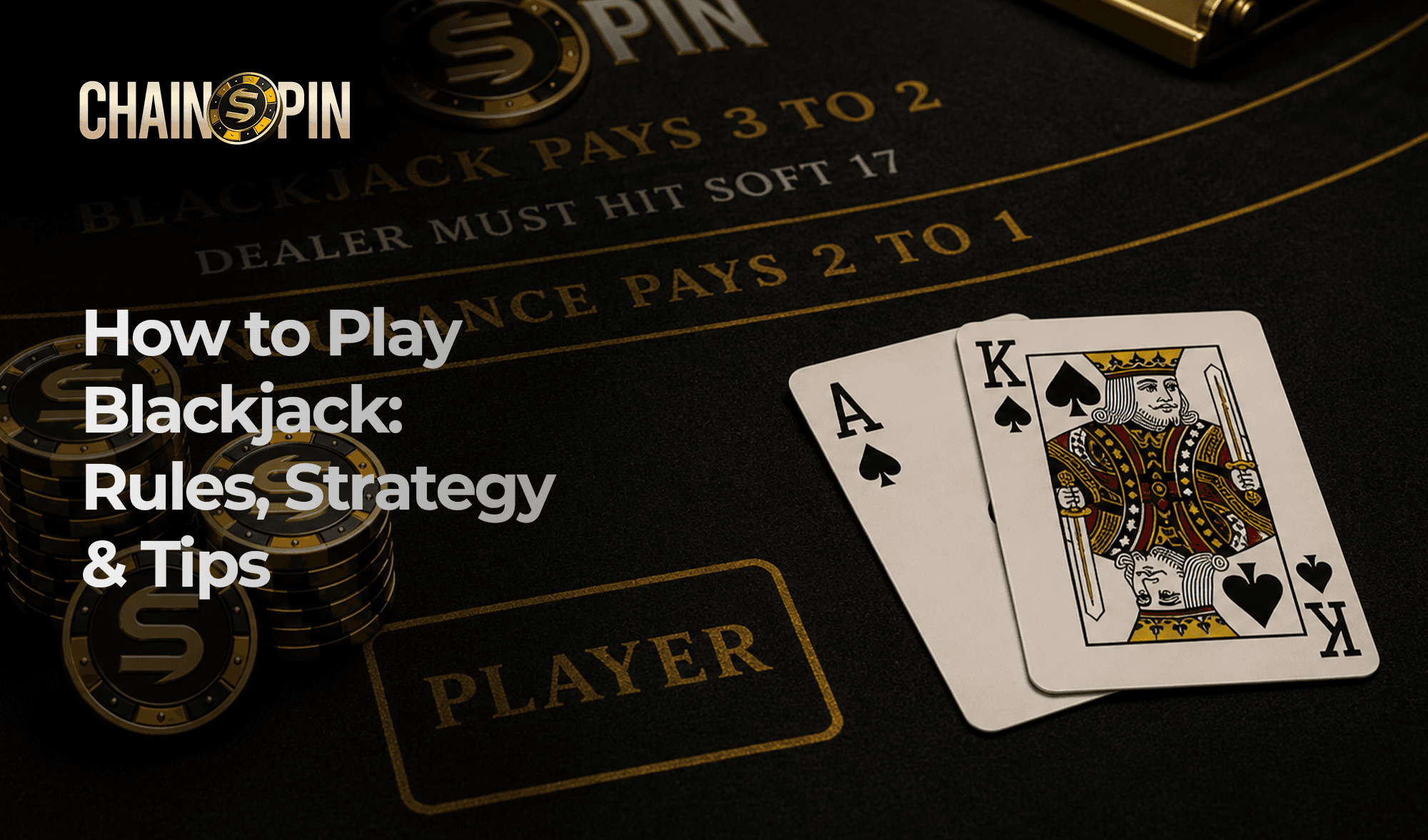
A “natural” or blackjack occurs when the opening two cards are an Ace and any 10-value card. It beats a regular total of 21 and pays 3:2 at standard tables. Some casinos have shifted to 6:5 payouts — a change that immediately increases the house edge by 1.39% and is worth avoiding whenever a 3:2 alternative exists.
If a hand exceeds 21, the player busts and the bet is lost instantly, before the dealer even plays.
Blackjack Game Flow
Every hand follows a five-step sequence that stays consistent across formats, stakes, and casino types.
Step 1: Place a bet. The player wagers before cards are dealt, within the table’s posted minimum and maximum limits.
Step 2: Deal the cards. The dealer gives two cards to the player and two to themselves. One dealer card is face-up. The other, the hole card, stays face-down until the player’s turn is complete.
Step 3: Player’s turn. Based on the visible cards, the player acts: hit, stand, double down, or split. Play continues until the player stands or busts.
Step 4: Dealer’s turn. The dealer flips the hole card and follows fixed rules. Hit on 16 or below. Stand on 17 or above. There’s no discretion, the dealer has no choices.
Step 5: Determine the winner. The highest hand at or under 21 wins. A tie called a “push” returns the player’s bet in full.
Player Actions and Decisions
Each action available to the player carries its own strategic logic. Knowing when to use each is what separates informed play from guesswork.
Hit – Request one additional card. Players can hit multiple times until they stand or bust.
Stand – Keep the current hand and end the turn. The dealer then plays.
Double Down – Double the original bet in exchange for exactly one more card. No further hits are permitted. Doubling is most effective when the player holds a strong total and the dealer shows a weak up-card.
Split – When two cards of equal value are dealt, they can be divided into two separate hands. Each hand receives an additional card and is played independently. The total bet doubles.
Surrender – Where available, the player forfeits the hand and recovers half the bet. It’s the correct play in a narrow set of high-disadvantage situations, not a default response to a bad hand.
Insurance – Offered when the dealer shows an Ace. A side bet that pays 2:1 if the dealer holds blackjack. The house edge on insurance exceeds 6%, making it a consistently poor bet for standard players. Avoid it.
Understanding Soft and Hard Hands
The distinction between soft and hard hands is one of the most practically important concepts in blackjack, and it directly determines which strategy decisions are correct.
A hard hand contains no Ace, or an Ace that must count as 1 to prevent busting. Hard 16 (10 + 6, or 9 + 5 + 2) is a classic example. With a hard hand, there’s no safety net. One wrong hit and the bust is immediate.
A soft hand contains an Ace currently counted as 11. Soft 17 (Ace + 6) is the most common instance: it reads as 17, but hitting cannot immediately bust it, since the Ace can drop to 1 if the next card pushes the total over 21. That flexibility changes the entire strategic calculation.
The practical difference matters most around 17. Soft 17 can be hit without risk of an instant bust; the worst case is a reclassified hard total. Hard 17 (10 + 7) has a roughly 69% chance of busting on any given hit. Treating these two hands as equivalent is among the most costly errors a new player can make. Understanding the rules of table games at any platform should include checking how the dealer handles soft 17, as that rule affects the house edge by approximately 0.2%.
Blackjack Basic Strategy
Basic strategy is the mathematically optimal play for every possible combination of player hand and dealer up-card. Developed through probability analysis and simulation of millions of hands, it reduces the house edge to 0.5% or below — the lowest of any standard casino table game. Following it consistently is the single most impactful thing any blackjack player can do.
The strategy responds to two variables: the player’s total and the dealer’s visible card. Each pairing has a statistically correct response. A full chart from Wizard of Odds covers every scenario in detail. Most casinos, both online and land-based, permit players to reference one during play.
Hard Hand Strategy
Hard hands are blackjack hands that do not contain an Ace counted as 11. Because there is no “flexibility” in the hand value, these situations require more careful risk management.
With hard totals between 8 and 11, the standard approach is usually to double down against a dealer showing 2 through 10. These hands have strong improvement potential, and doubling down allows players to maximize value when the odds are favorable.
A hard 12 is more situational. Players should generally stand when the dealer shows 4, 5, or 6 because these are weak dealer cards with a higher chance of busting. Against stronger dealer cards, hitting is preferred to improve the hand.
For hard totals between 13 and 16, the strategy becomes defensive. Players should stand against dealer cards 2 through 6, again relying on the dealer’s higher bust probability. However, when the dealer shows 7 or higher, hitting becomes necessary because the dealer is statistically more likely to complete a strong hand.
Any hard total of 17 or more should always stand. The risk of busting by taking another card outweighs the potential benefit.
Soft Hand Strategy
Soft hands contain an Ace counted as 11, giving the player more flexibility because the Ace can revert to a value of 1 if needed. This makes soft hands less risky to play aggressively.
With soft totals between 13 and 17, players should double down against dealer cards 3 through 6. These situations combine strong improvement potential with a weaker dealer position. If doubling is not favorable, hitting remains the preferred option.
Soft 18 is one of the most versatile hands in blackjack. Against dealer cards 3 through 6, doubling down is typically the strongest play. Against most other dealer cards, standing is the safer choice because the hand is already relatively strong.
Soft 19 or higher should always stand, as these totals already place the player in an excellent position.
Pair Splitting Strategy

Pair splitting allows players to turn one hand into two separate hands, potentially improving overall value. However, not every pair should be split.
Aces and 8s should always be split. Splitting Aces creates two opportunities to build strong hands starting from 11, while splitting 8s avoids being stuck with a weak total of 16.
By contrast, 10s and 5s should never be split. A pair of 10s already forms a powerful total of 20, while splitting 5s weakens what is effectively a strong starting hand of 10.
Lower pairs are more dependent on the dealer’s up-card. Pairs of 2s and 3s are best split against dealer cards 4 through 7. Sixes should be split against dealer 3 through 6, while 7s are commonly split against dealer 2 through 7. Nines are usually split against dealer 2 through 9, except when the dealer shows 7, where standing is generally stronger.
Understanding the Dealer’s Up-Card
The dealer’s visible card is the foundation of blackjack strategy. When the dealer shows a weak card between 2 and 6, the dealer is more likely to bust. In these situations, strategy becomes more conservative, with players often standing and allowing the dealer to self-destruct.
When the dealer shows a strong card such as 7, 8, 9, 10, or Ace, the dynamic changes completely. The dealer now has a much higher probability of completing a strong total, so players must take a more aggressive approach by hitting or doubling down more frequently to remain competitive.
Blackjack Variations
Classic blackjack, where 3:2 payout, dealer stands on hard 17, full split and double-down options, carries the lowest house edge of any variant and is the version for which basic strategy was originally designed.
European blackjack gives the dealer only one card initially. The hole card is not dealt until after the player finishes their hand, which means the dealer does not check for blackjack upfront. Players who double or split against what turns out to be a dealer blackjack lose the additional bets. This creates a modest but real disadvantage versus the standard format.
Spanish 21 removes all 10-rank cards from the deck entirely (face cards with a value of 10 remain). Liberal rule additions, such as expanded doubling and splitting options, are offered to compensate. Despite those additions, the house edge is typically higher than classic blackjack, making it less favorable for basic strategy players.
Live dealer blackjack streams a real-time game with a human dealer managing physical cards at a table. The format closely replicates the land-based experience and operates under the same blackjack rules. Chainspin’s live casino offers provably fair live dealer blackjack tables, with outcomes verifiable through cryptographic seed confirmation.
House Edge in Blackjack
With basic strategy, the house edge in blackjack sits between 0.5% and 1%, making it one of the most competitive games available in any casino. Without strategy and relying on instinct, that figure rises to 2–4%.
Three rule variations have an outsized impact:
Blackjack payout is the largest factor. The shift from 3:2 to 6:5 adds 1.39% to the house edge immediately. Any table paying 6:5 on a natural should be avoided when a 3:2 alternative is accessible.
Dealer soft 17 rule. When the dealer is required to hit soft 17 (a rule common in multi-deck games), the house edge increases by approximately 0.2%. This is usually printed on the table felt.
Surrender availability reduces the edge by around 0.08% for late surrender small. Choosing between games based on these rule specifics is one of the most practical adjustments any player can make.
Common Blackjack Mistakes
The most expensive mistake is ignoring basic strategy. When players rely on intuition instead of mathematically correct decisions, the house edge increases by roughly 1.5 to 3.5 percentage points, depending on the situation.
A common example is hitting on 12 against a dealer’s 4–6. Basic strategy says to stand. In this spot, the dealer is more likely to bust, and hitting gives up that advantage too early.
The opposite mistake is failing to double down when the odds are in your favor. For instance, doubling on 11 against a dealer’s 6 is a positive expected-value play. Skipping it doesn’t cause an immediate loss, but it reduces your long-term returns.
Taking insurance may seem like a smart safety net, but it isn’t. The bet carries a house edge of over 6%, making it unprofitable in standard play.
Finally, chasing losses by increasing bet sizes after a losing streak doesn’t improve your chances. Each hand is independent, and this approach only leads to faster bankroll losses when variance is against you.
Blackjack Tips for Crypto Casinos
Playing Bitcoin blackjack at a crypto casino introduces a specific set of considerations that don’t apply at traditional online platforms.
Verify Provable Fairness
Reputable crypto casinos use provably fair systems that allow you to independently confirm each hand through cryptographic hashes. Before depositing, make sure the platform publishes seed values and provides a clear verification tool.
Check the Payout Rules
A 3 to 2 payout is the standard to look for. Some tables, especially lower stake ones, use 6 to 5 instead. This detail is easy to miss but significantly increases the house edge over time.
Understand Bonus Wagering
Blackjack usually contributes only 10 to 20 percent toward wagering requirements, compared to 100 percent for slots. This reduces the real value of most welcome bonuses, so review the terms carefully before claiming one.
Manage Your Bankroll
A good rule is to bet 1 to 2 percent of your total session budget per hand. Set both a loss limit and a win target before you start playing.
Crypto casinos often process withdrawals within minutes, which is a clear advantage. At the same time, that speed can make it easier to deposit again after a loss. Treat fast withdrawals as a tool for discipline, not a reason to chase losses.
Blackjack Betting Strategies
Betting systems and basic strategy are not the same thing. Confusing them often leads to unrealistic expectations.
Flat Betting
Flat betting means using the same wager on every hand. It is the most stable and sustainable approach. It will not increase your winnings, but it helps prevent large losses during a losing streak.
Progressive Systems
Progressive systems, such as the Martingale, increase bet size after losses. The idea sounds logical, but it does not hold up in practice. No betting system can overcome the house edge.
With Martingale, bets grow quickly during a losing run. Table limits also prevent you from doubling indefinitely, which the system depends on to recover losses. In the long run, the expected loss per dollar wagered remains the same regardless of how bets are structured.
Card Counting
Card counting is a strategy that tracks the ratio of high to low cards remaining in the deck. This can shift the odds slightly in the player’s favor.
While it is legal in many places, casinos actively counter it through frequent shuffling and by restricting players who are identified as counters.
Card counting does not work in online or crypto blackjack. These games use random number generators that reshuffle after every hand, which removes any advantage gained from tracking card distribution.
Playing Blackjack Responsibly
Blackjack’s low house edge and strategic framework make it genuinely engaging, but that engagement can make it easy to extend sessions beyond planned limits. Responsible play isn’t a formality; it’s what makes the game sustainable over time.
Set a session budget before sitting down, not during play. Define a loss limit and a win goal, and stop when either is reached. Time limits are as effective as monetary ones.
Gambling winnings should not be treated as reliable income. Only play with money you can afford to lose without affecting your daily life.
If playing stops being enjoyable or begins to impact other areas of your life, it is important to take a step back. Chainspin offers responsible gambling tools, including deposit limits, session limits, and self-exclusion, all available directly in your account settings.
For a full range of live dealer and classic blackjack options with provably fair verification, explore the game library at Chainspin’s table games.
Frequently Asked Questions about Blackjack
What is the best blackjack strategy?
Basic strategy is the mathematically optimal way to play every hand. It uses your total and the dealer’s up-card to guide decisions. When followed consistently, it reduces the house edge to around 0.5%.
Should I take insurance?
No. Insurance carries a house edge of over 6% and lowers your expected return. It only makes sense for card counters, which does not apply in online or crypto blackjack.
When should I double down?
Double on hard 11 against most dealer cards, hard 10 against 2–9, and hard 9 against 3–6. For soft hands, double 16–18 against 3–6. These spots offer the highest expected value.
When should I split?
Always split Aces and 8s. Never split 10s or 5s. Split 9s against 2–9 except 7, 7s against 2–7, and 2s or 3s against 4–7.
What is the house edge in blackjack?
With basic strategy, the house edge is about 0.5–1%. Without it, it rises to 2–4%. Rules like 3:2 payouts and dealer behavior also affect the edge.
Can I count cards online?
No. Online and BTC blackjack reshuffle after every hand, which makes card counting ineffective. It only works in physical games with a fixed shoe.
What is a soft 17?
A soft 17 is a hand with an Ace counted as 11, such as Ace + 6. It cannot bust with one hit, making it more flexible than a hard 17.
Should I hit on 12?
Stand on 12 against a dealer 4–6. Hit against 2, 3, or 7 and higher. The decision depends on the dealer’s likelihood of busting.
Is blackjack beatable?
Not with basic strategy alone. The house still has a small edge. Strategy minimizes losses, making blackjack one of the most favorable casino games.
Where can I play blackjack?
Explore a range of classic and live dealer options in the table games section, including crypto-friendly blackjack variants.